Voldemar Herkel, Mai Roosna, 1965. EAM MK 174
The passenger pavilion of the Port of Tallinn
The passenger pavilion in the Port of Tallinn was opened on July 7, 1965, when the travel connection between Tallinn and Helsinki, interrupted during the war, was restored. The pavilion, designed by architects Voldemar Herkel and Mai Roosna, reflected contemporary Finnish-influenced architecture. The walls of the pavilion were formed by shields with a load-bearing steel frame, which were filled with glass or partly with wood. The floor-to-ceiling glass walls of the building opened the view to the sea; wooden shields were used on walls where, based on the function of the rooms, more privacy was needed. In contrast to the wide white cornice of the horizontal roof, the building’s clapboards were covered with dark pine tar. Building ventilation and air heating pipes were placed inside the eaves, rainwater was drained from the corners of the roof. The unity of the interior and exterior of the pavilion was also important in the design. The suspended ceiling with strip lights used in the interior moved smoothly with the same rhythm over the ceiling of the canopy, the terraces of the building and the floors of the common rooms were covered with the same dolomite tiles. The partially landscaped courtyard in the middle of the building made the interior of the pavilion more spacious and added a little greenery to the harbour environment.There was a waiting room for international travelers in the seaside part of the pavilion, and a cafe-bar operated in the back of the room. A smaller waiting room in another side of the building was intended for passengers of local ship lines. In addition, there were offices, a currency exchange point and the foreign tourism office Inturist in the pavilion. The passenger pavilion was demolished a few decades after its completion. The model of the building was made by Peet Veimer in 2008 for the exhibition “Architect and his time. Voldemar Herkel” curated by Karin Hallas-Murula. Text: Anna-Liiza Izbaš
-
-
The Architects’ House
-
-
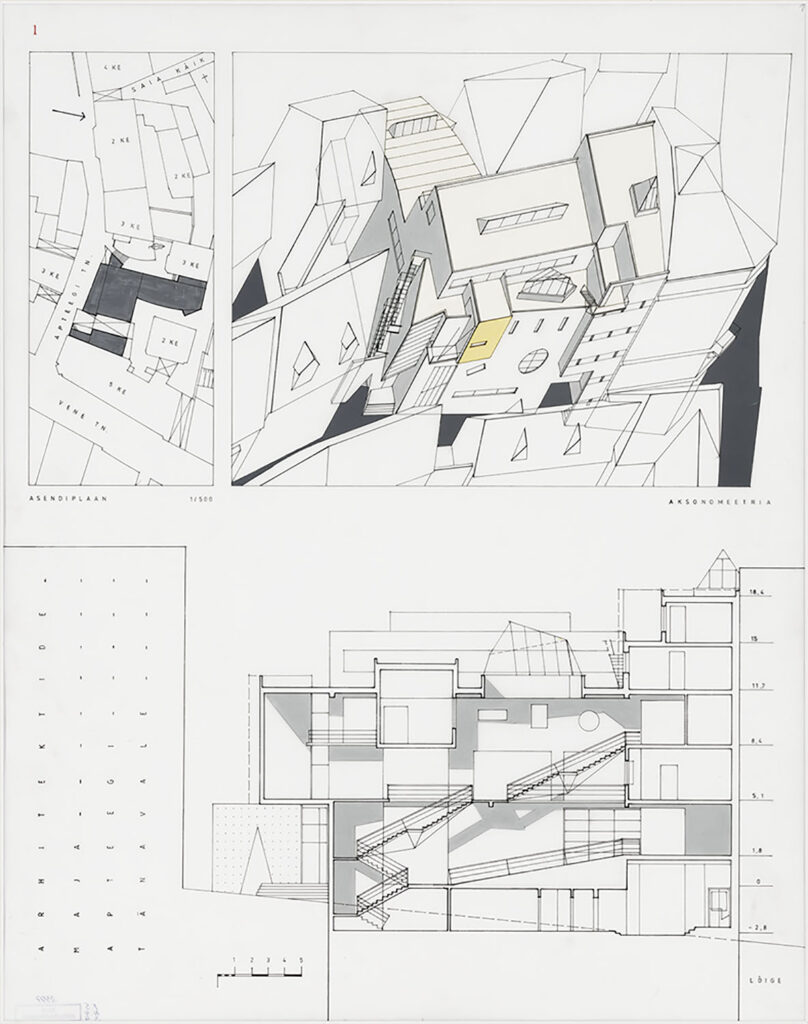
Site plan, axonometry and section.
-
-
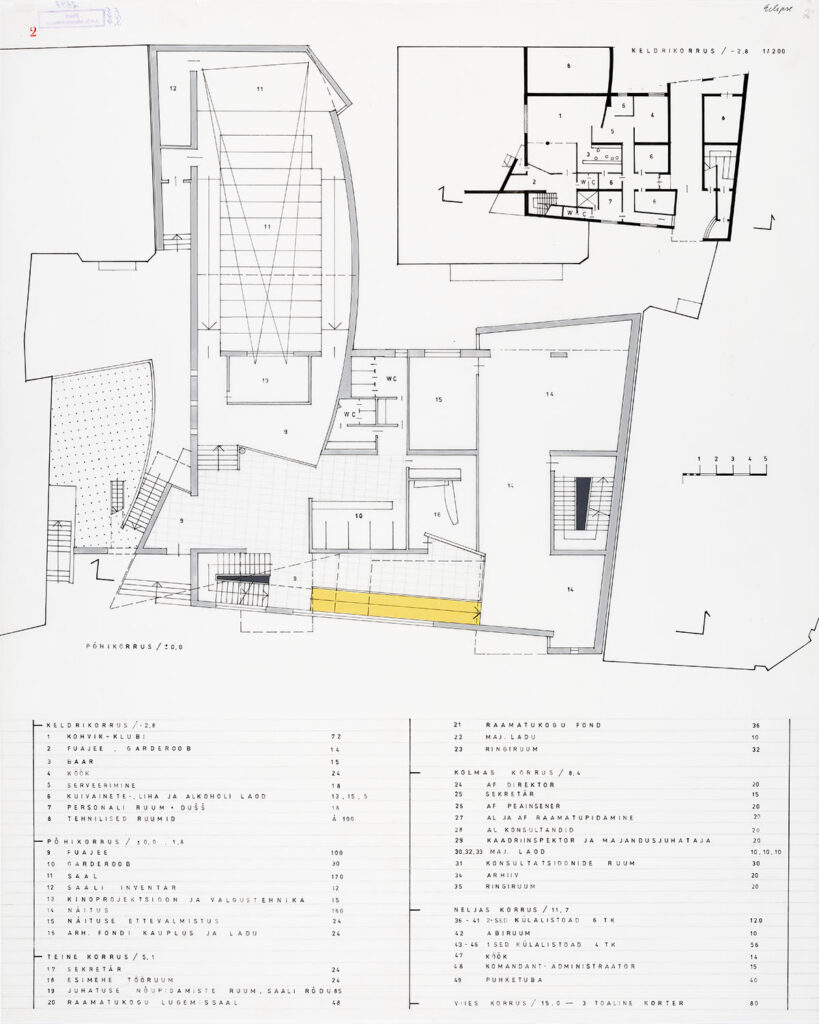
1st floor and basement plan.
-
-
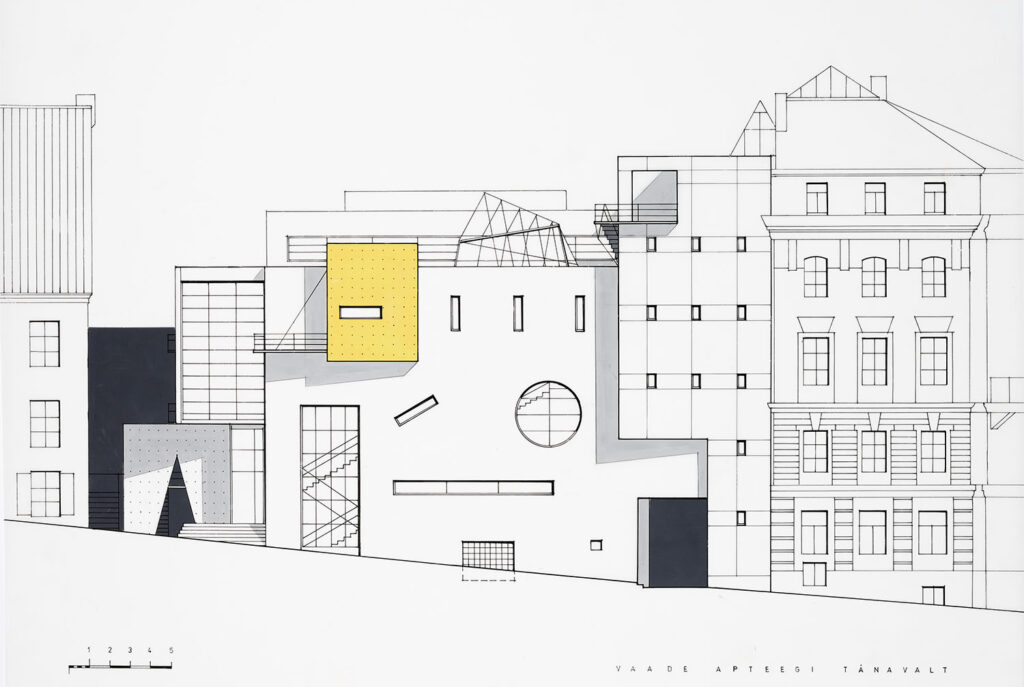
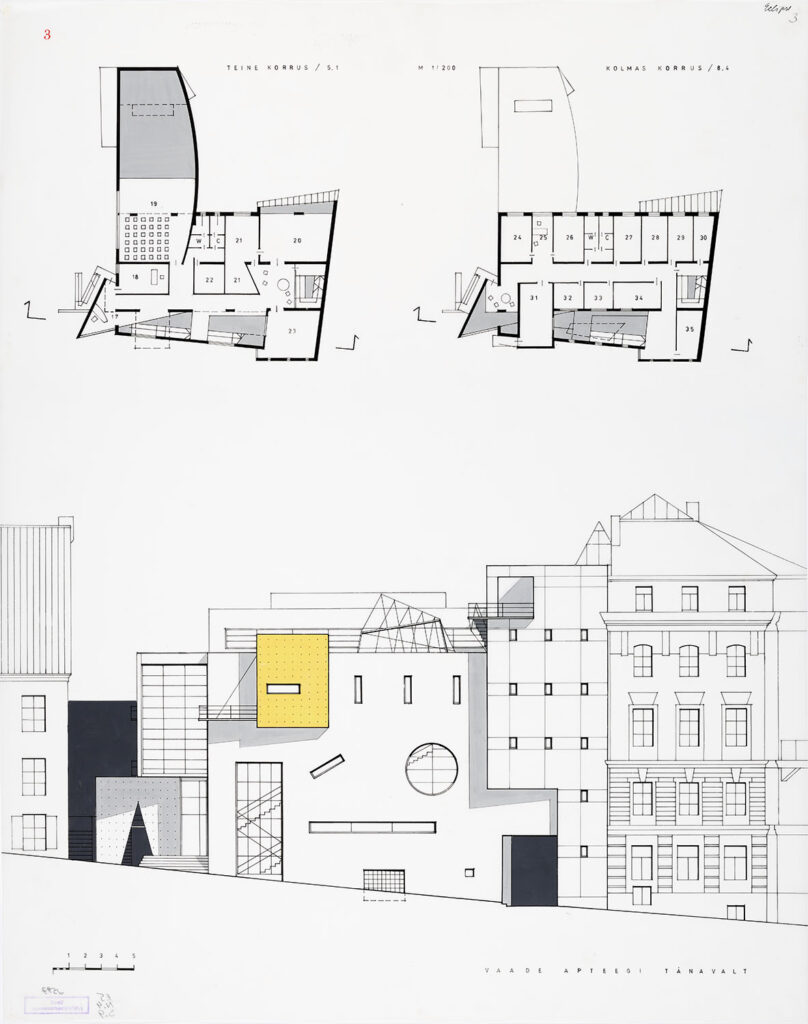
View from Apteegi Street, 2nd and 3rd floor plan.
-
-
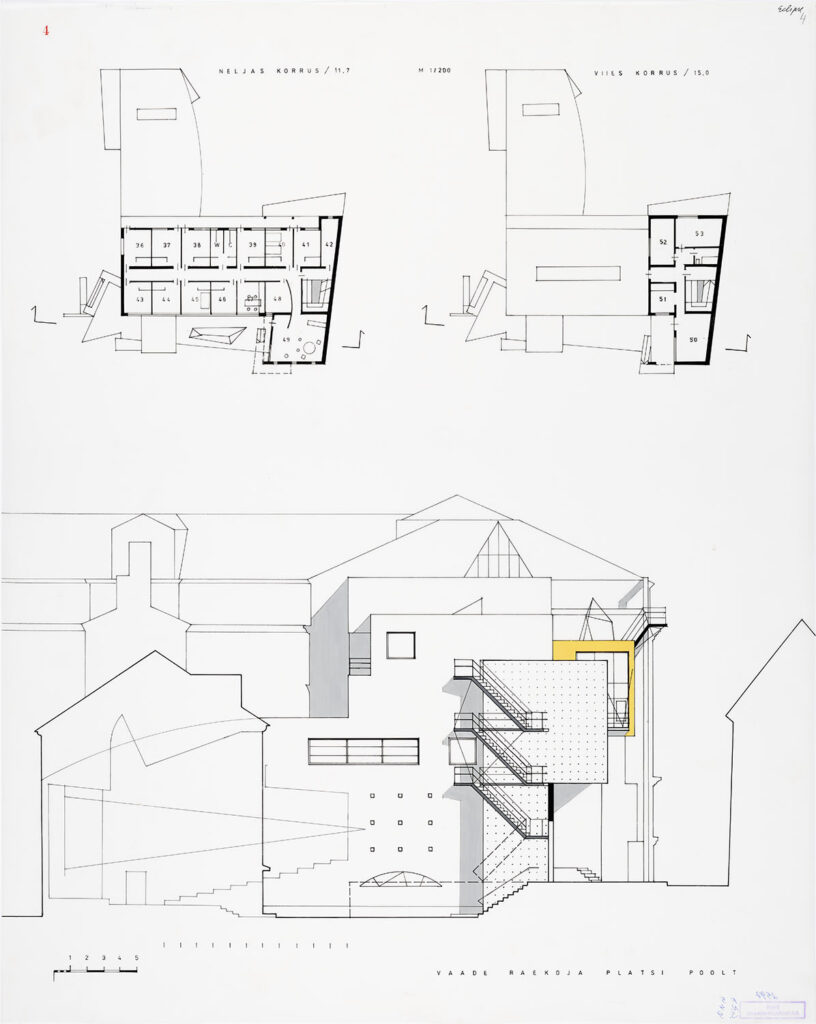
View from Town Hall Square, 4th and 5th floor plan.
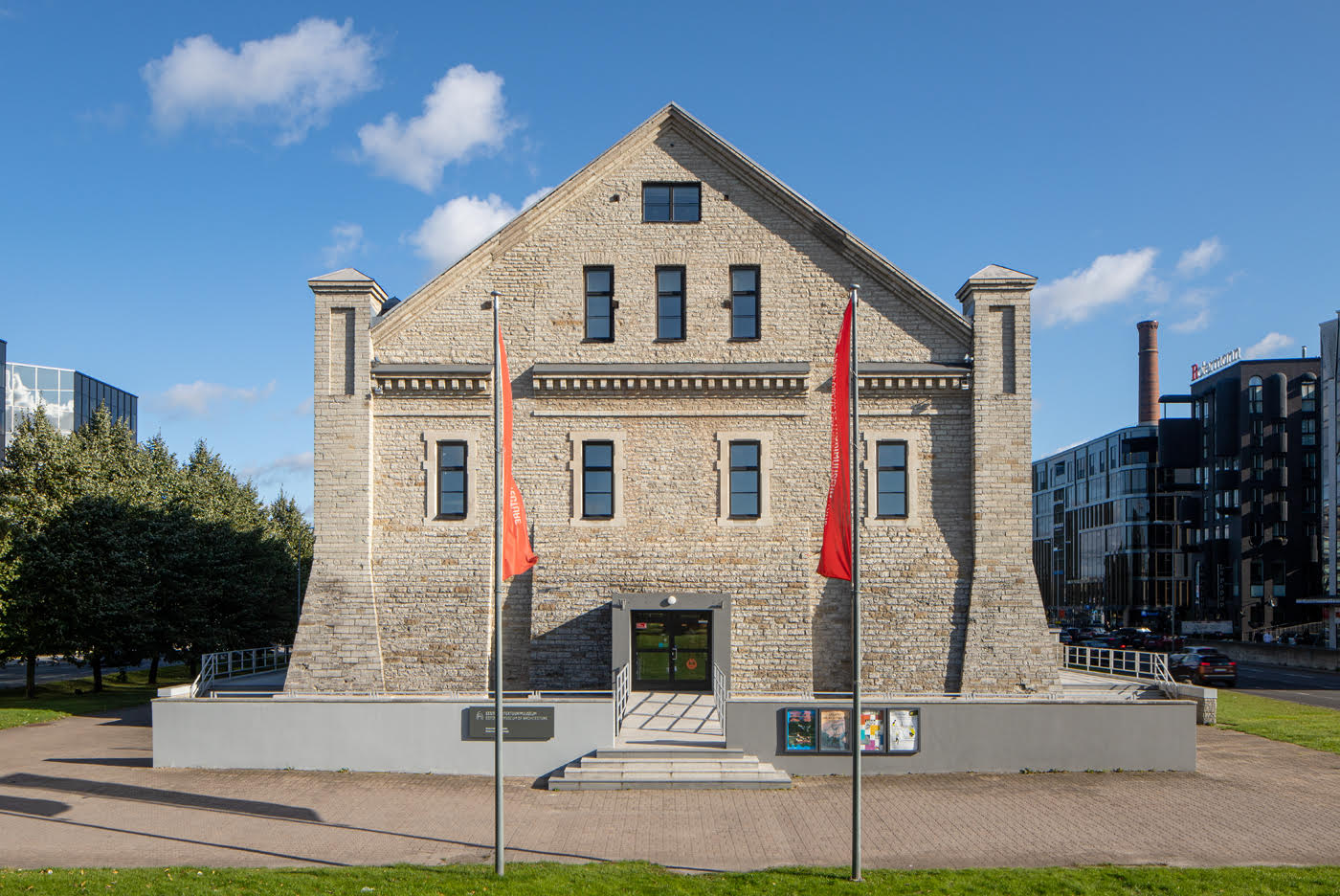
Andres Siim, 1989. EAM 5.4.9
The Architects’ House
The Architects’ House was to become the centre of Estonian architectural life, replacing the buildings destroyed during the war on the Apteegi Street in Tallinn’s old town. Among the 11 entries in the architectural competition, which ended in the spring of 1989, the design “Eclipse” by architect Andres Siim stood out. His work corresponded to the vision of the architects’ house and was awarded the first prize in the competition. The building had to be based on the structure of historically developed properties in the old town; the new building had to represent contemporary architecture in a dignified manner, while the volume of the building, the articulation of the facade and the roofscape had to match the milieu of the old town. The jury highlighted the conformity of the external and internal spatial solution, the multi-layered and interesting floorplan of the Architects’ House designed by Andres Siim. The narrow plots, characteristic of the old town, were clearly reflected in the facade design of the building, the special-shaped windows and the yellow section of the building added character. In addition to work and meeting rooms, a hall and library, cinema projection, archive and exhibition rooms and a cafe-club room were planned for the Architects’ House. Although the design of the building received positive feedback, the future progress of the project was difficult. The dream of an architects’ own house faded behind the bureaucracy of the authorities, construction and financial issues. A noteworthy project was not built. Text: Anna-Liiza Izbaš
(klick on the picture to see more illustrations)
Peep Jänes, Henno Sepmann, Rein Kersten, Loona Kikkas, 1986. EAM 5.4.35
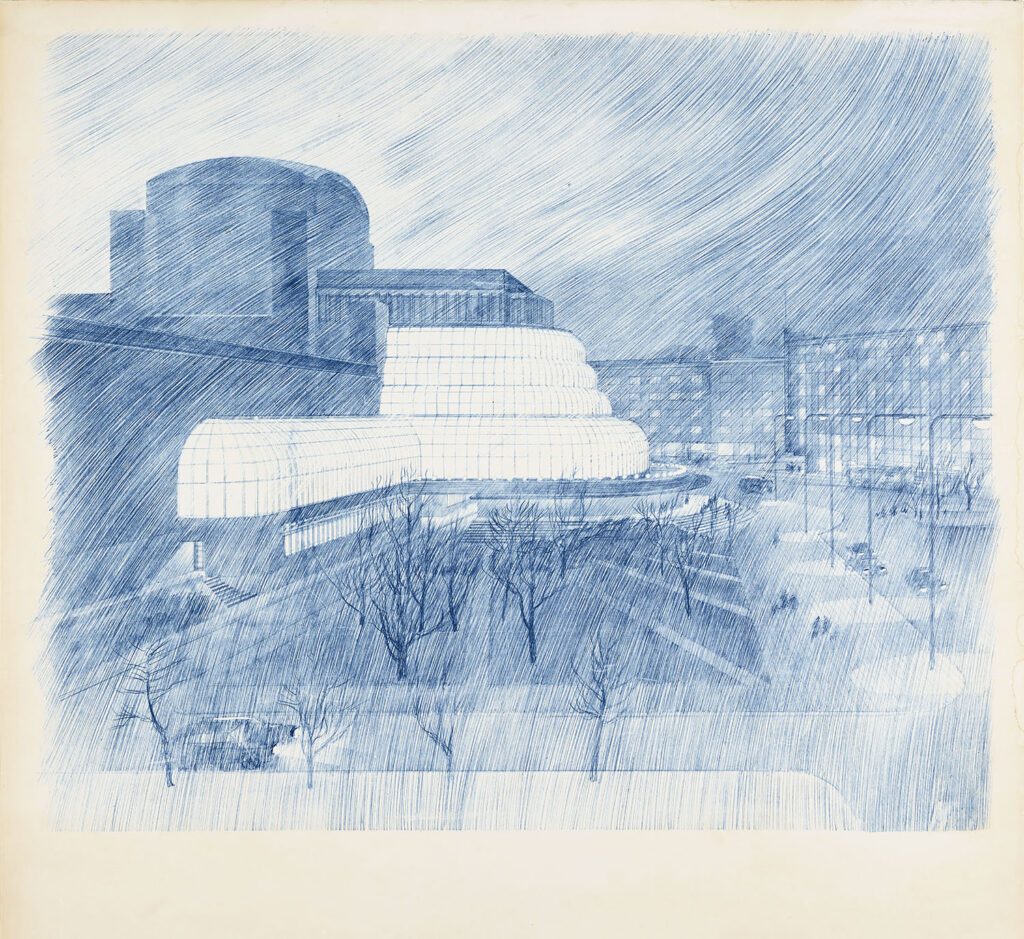
Opera and ballet theatre
Tallinn’s new opera and ballet theatre was planned to be built in the area of Süda Street, in the intersection of Pärnu Road, Süda Street and the planned extension of Rävala Boulevard. Architects Peep Jänes and Henno Sepmann won the invited architectural competition in 1984. A year later, together with architects Rein Kersten and Loona Kikkas, they began designing an opera theatre that meets modern requirements. The project of the new opera house was grandiose. The most spectacular part of the building, the brightest in the evening, was to be the curved glass facade. A powerfully shaped stage tower was to crown the central part of the building To balance the scale of the building, the choice of materials and colours was modest: grey reflective glass, silver grey glazed brick and dolomite, to make the building look harmonious with the historical buildings and Tallinn Town Wall. The theatre building’s large hall with four balconies had to accommodate 1,100 spectators. The choice of the location of the monumental building caused an active discussion in the society; there were both passionate supporters and ardent opponents. The new opera and ballet theatre would have significantly changed the milieu of the Süda Street area, the existing buildings would have been demolished and a number of trees, including the protected ginkgo tree, would have been cut down. To preserve the ginkgo, a square was planned in front of the opera house. The design process for the new opera house, which lasted several years, ended in November 1988 and the building was never constructed. Text: Anna-Liiza Izbaš
Anton Soans, Edgar Johan Kuusik, 1932-1933. EAM 16.1.39
Sketches of the facade of the Tallinn Art Hall
Designed by architects Anton Soans and Edgar Johan Kuusik, the Tallinn Art Hall is one of the most outstanding examples of functionalism in Estonia. In order to find the most suitable facade design, the architects sketched different solutions – the drawings show different designs for the entrance to the building, the arrangement of windows and the details on the facade. The facade solution of the building also changed slightly during the construction works, when the initially planned round windows were replaced with vertical niches. The cornerstone of the Tallinn Art Hall was laid on August 29, 1933, and it was officially opened with an art exhibition on September 15, 1934. The modernity of the originally five-storey building with a T-shaped ground plan is emphasized by the main entrance of the building that is stepping back from the street line and the central part of the front facade that is resting on two pillars, as well as the flat roof of the building. The glass screen located in the middle of the facade, as if placed inside a frame, connects the artists’ studios, office spaces and exhibition hall located on different floors on the facade into one. In 1937, the bronze figures “Work” and “Beauty” designed by the sculptor Juhan Raudsepp were placed in the niches of the facade. According to the project of Edgar Johan Kuusik, the last floor of the Art Building was rebuilt in 1962, as a result of which the building became as high as the adjacent Art Foundation building (architect Alar Kotli). In 1993, Ado Soans, son of Anton Soans, donated the facade drawings to the museum. Text: Anna-Liiza Izbaš
(klick on the picture to see more illustrations)
August Volberg, Heili Volberg, 1958. EAM 31.1.37
Writers’ House
The Writers’ House in Tallinn old town was opened in the spring of 1963. The project of the four-storey building was designed by the architects August and Heili Volberg at the national design institute “Estonprojekt” in 1958. The seemingly laconic Writers’ House is characterized by the rationality typical of modernism. The regularly spaced windows indicate the different functions of the building – spaces for public use are located behind the large windows, private living spaces are hidden behind the smaller three-part windows. The building is connected to the historical architectural environment by a high pitched roof that fits the rooftop landscape of the old town. On the ground floor next to Harju Street, there was a book store called “Lugemisvara” with large display windows. On the corner of Harju and Vana-Posti streets, the cafe “Pegasus” with a modern interior design is located on three floors. A vestibule with a wardrobe and auxiliary rooms were originally planned in the first floor. On the next two floors are the halls of the cafe, the windows of which offer a view of St. Nicholas Church, the verdant green area and the Eduard Vilde monument. The floors of the cafe are connected by a spiral staircase. The premises of the Estonian Writers’ Union and a 150-seat meeting hall with an expressive black ceiling are located in the three-storey part of the building facing Kuninga Street. There was also space for the editors of the “Looming” magazine and the Literary Fund. In addition to the public function, two to five room apartments for writers and their families were planned in the building. In the larger apartments, one room was planned as a writer’s workspace. During the later reconstruction, the fifth floor of the house, under the roof, was built. Text: Anna-Liiza Izbaš
(klick on the picture to see more illustrations)
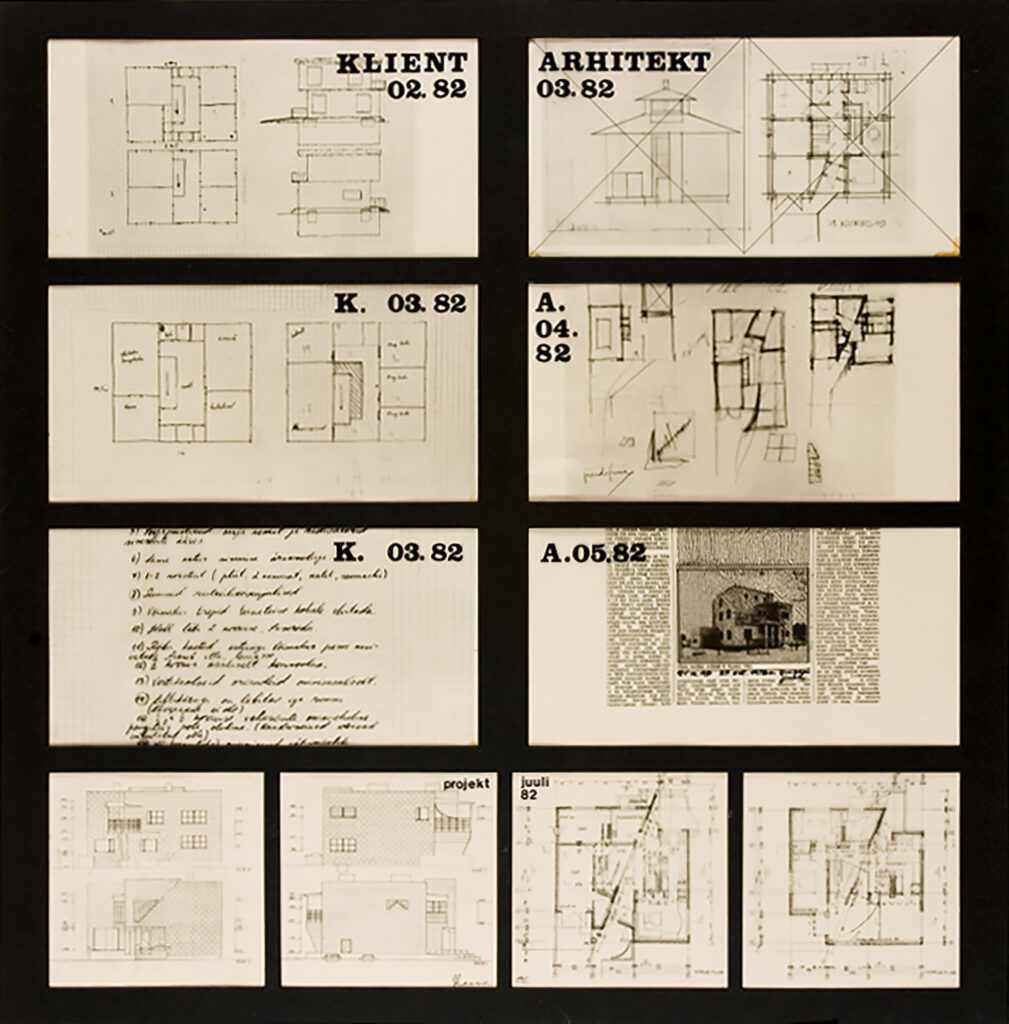
Veljo Kaasik, 1982. EAM K 31
Dialogue “Client-architect”
“Client-architect” by Veljo Kaasik is a visual dialogue between the architect and the client. The work depicting the design process of a private house located on Nisu Street in Tartu shows how the building is completed in cooperation between an ambitious architect and a demanding client. Both parties are connected to each other from the planning of the building until its completion. The architect’s imaginative ideas are often influenced by the different sense of aesthetic and disagreements of the parties involved. Mostly, compromises are made. The final result is more or less different than originally planned. Veljo Kaasik’s work was on display at the exhibition of ten architects in the salon of the Tallinn Art Hall Gallery (exhibition 23.12.1982–9.01.1983). Text: Anna-Liiza Izbaš
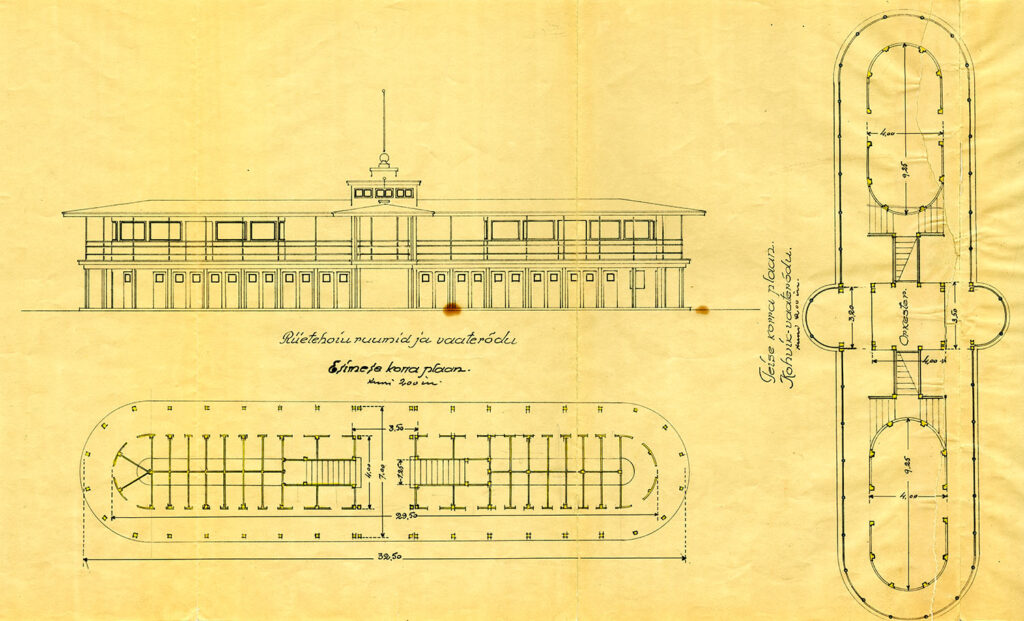
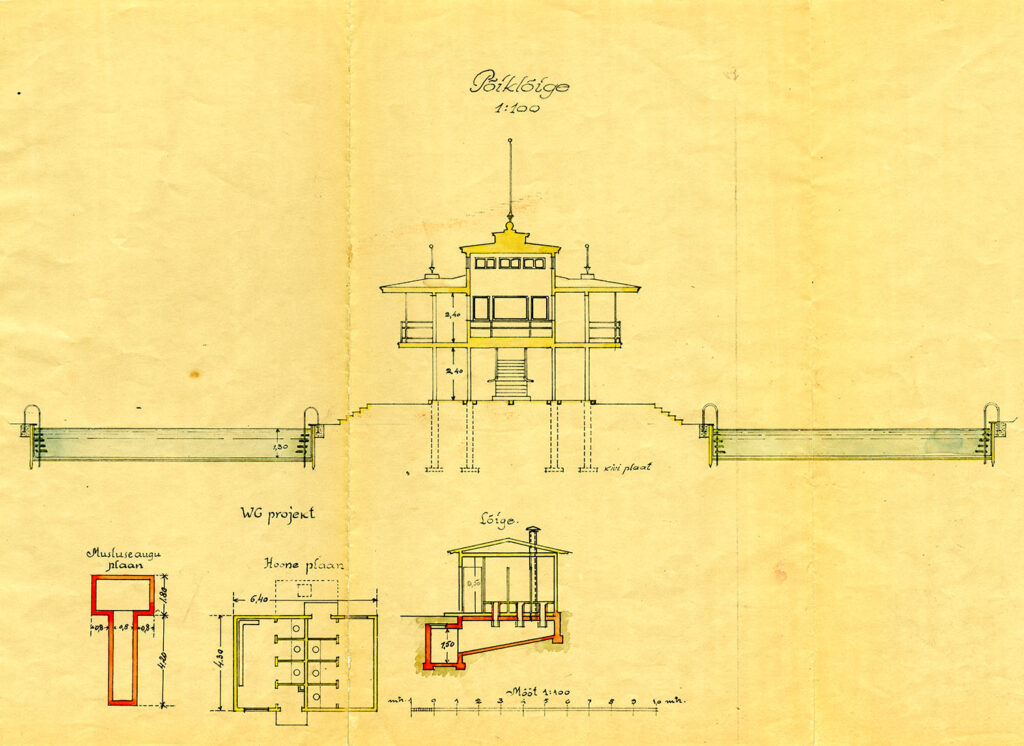
Tõnis Mihkelson, 1936. EAM 2.6.53
Mustamäe bathing facility
Under the lead of entrepreneur Johan Must, a bathing facility was built in Nõmme under the slope of Mustamäe. The town of Nõmme granted a construction permit for the facility in 1927, but the construction work was delayed due to land ownership disputes. In 1934, Johan Must acquired the necessary land. He received a loan from the Ministry of Economy to build a bathing facility, construction work began in the fall of 1935. Mustamäe bathing facility was designed by architect Tõnis Mihkelson. In 1936, a cafe building and a 50-meter swimming pool were completed. A year later, changing rooms, another slightly deeper pool, a water jumping tower and a swan pond were opened. In order to obtain a water temperature suitable for swimming, cold spring water was directed through four pre-heating pools, and artificial waterfalls were built to ensure water quality. A functionalist wooden cafe building was located between the two swimming pools. There were dressing rooms on the first floor, a balcony and a separate area for the orchestra on the second floor. In addition, a staircase was planned on the slope of Mustamäe, which led to Nõmme’s garden city. Domestic and international swimming competitions were held in the swimming pools, chess tournaments were regularly held in the cafe building. In winter, people could enjoy winter swimming and ice skating.The cafe building of the Mustamäe bathing facility was destroyed in 1974. Text: Anna-Liiza Izbaš
(klick on the picture to see more illustrations)