Heili Volberg, 1970. EAM 51.1.4
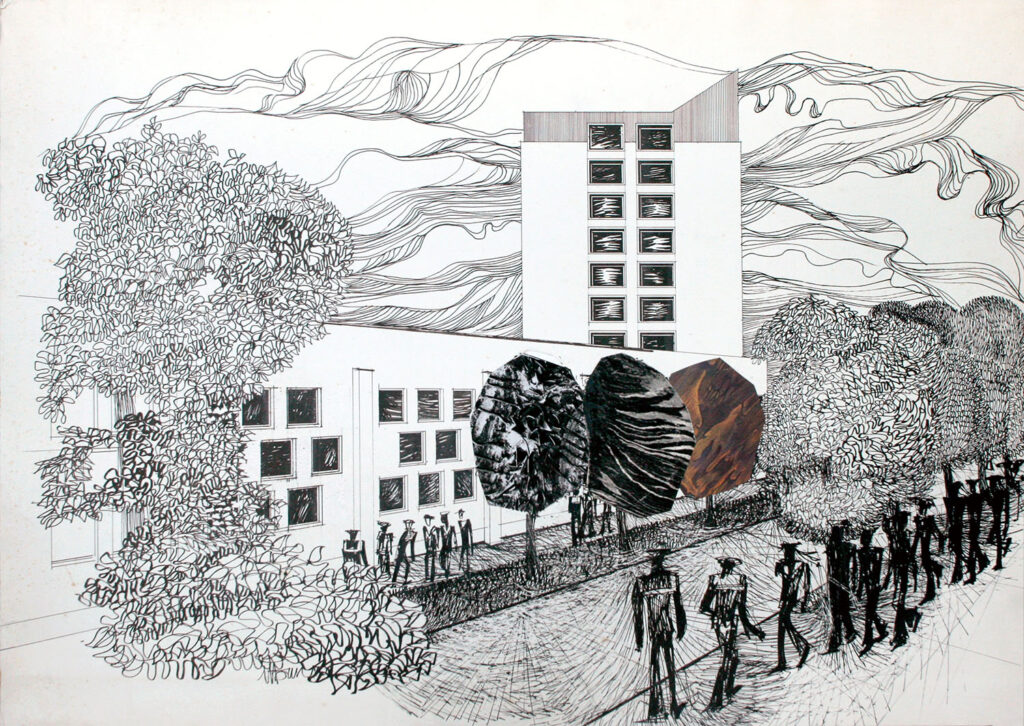
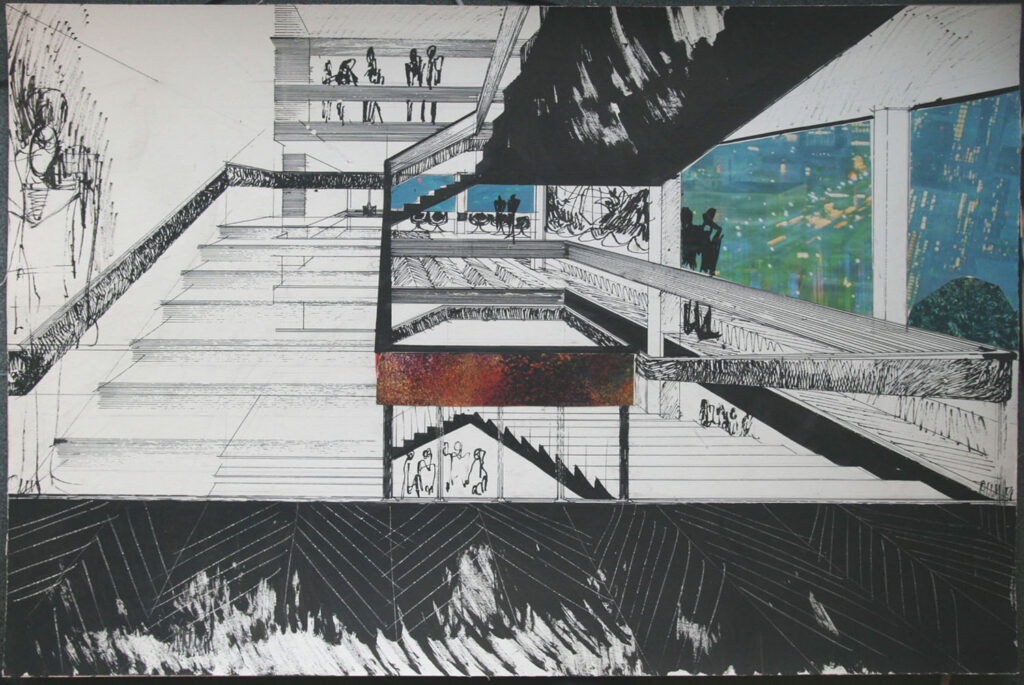
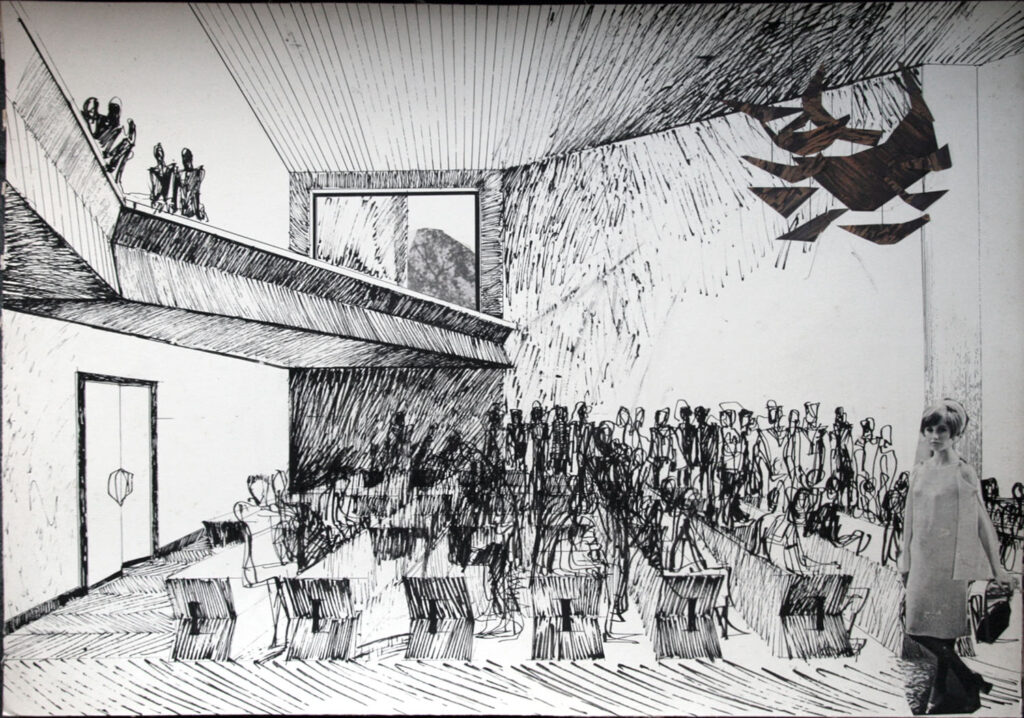
Pärnu Maritime School
In 1970, architect Heili Volberg designed an extension to the dormitory of the maritime school located by the moat in Pärnu. Spacious classrooms, an auditoorium and a sports hall, even a hairdresser’s office, was planned in the educational building. Pärnu Maritime School was closed and the project was not completed. The school dormitory was reconstructed and the Viiking health center was opened in the building at the beginning of August 1993. The boards of Pärnu Maritime School were designed by interior architect Aate-Heli Õun using the collage technique. The work was donated to the museum by architect Heili Volberg-Raig in 2013. Text: Anna-Liiza Izbaš
(klick on the picture to see more illustrations)
Nora Tammoja, 1964. EAM 11.1.32
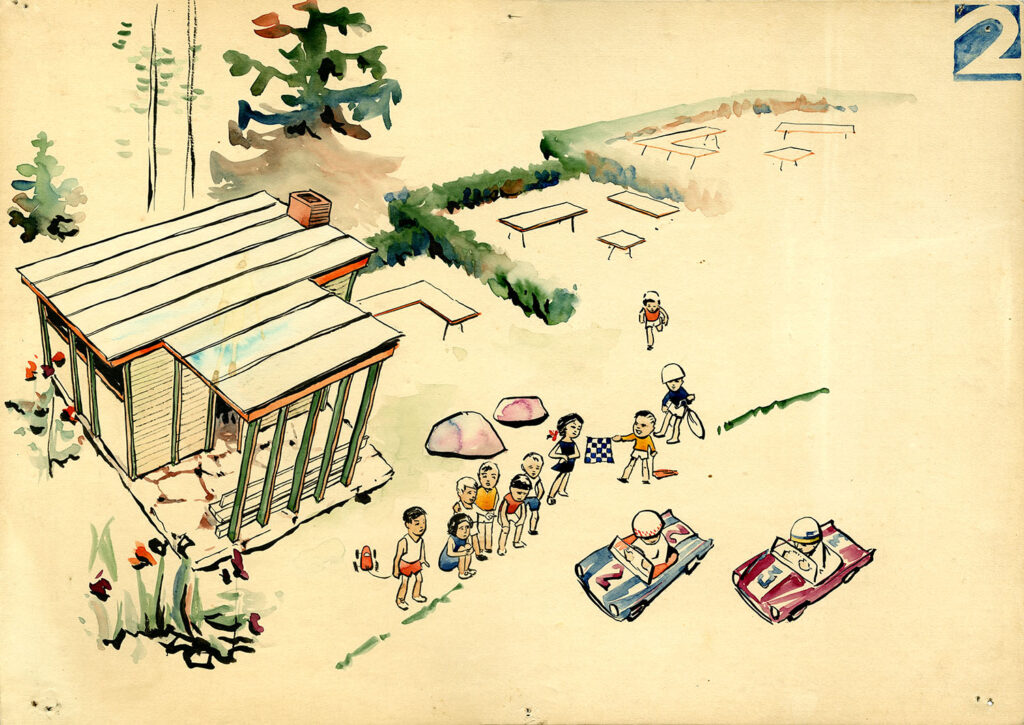
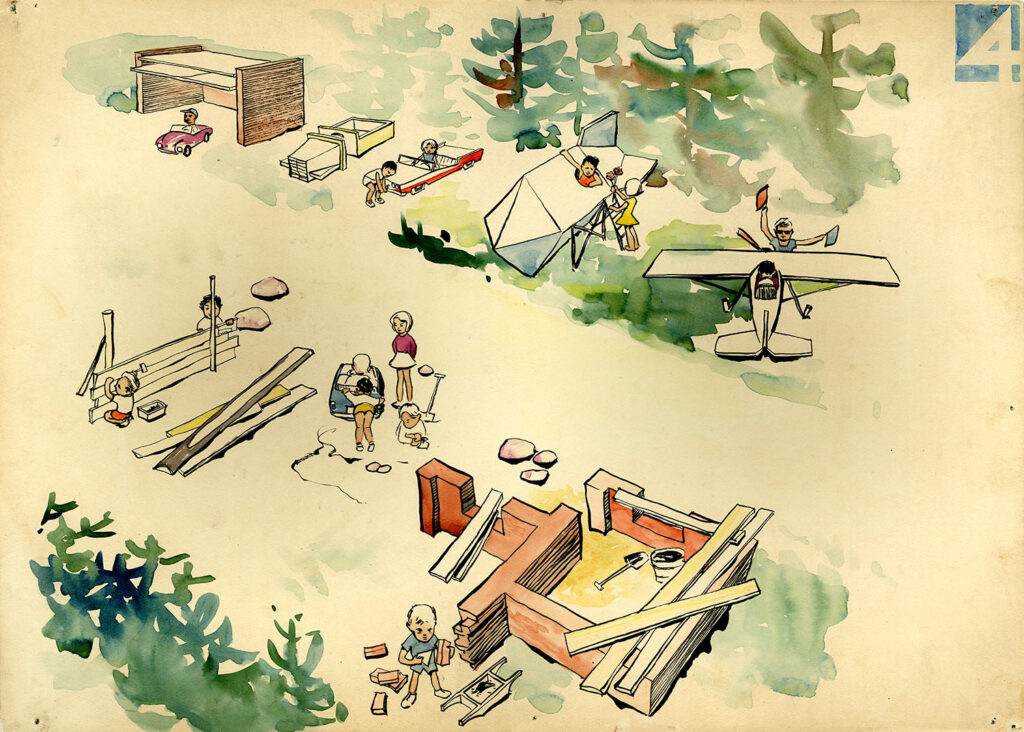
Children’s park in Sindi
Landscape architect Nora Tammoja has created numerous projects for urban green areas, cemeteries and children’s playgrounds. The design of children’s park in Sindi (Sindi Lastepark) was completed in 1964, the co-author of the project was architect Kaarel Pedak. The playground included playhouses and shelters, a climbing and sledding hill with a tunnel inside, a swing area, a traffic lane, a sandbox and a Robinson square. Robinson square was a playground construction site where children could build various buildings according to their imagination. The materials needed for construction were collected from various construction sites and were placed in the material warehouse on the playground. Since construction was considered primarily a boy’s activity, a separate play area for girls was planned in the park. The girls’ playhouse consisted of several rooms, one of which had a toy stove, and there was also a shop-pharmacy. In the middle of the playground was a two-way traffic lane with crosswalks and traffic signs. In the centre of the track was a circular traffic island intended for the position of a traffic controller. Sindi Lastepark with various play elements was mainly intended for preschool children and students of younger grades. On the back side of the project photo (EAM 11.1.69), it is noted that the work was awarded a silver medal at the National Economic Achievements Exhibition in Moscow in 1964. Construction work on the children’s park began in 1965, but probably not everything planned was completed. Text: Anna-Liiza Izbaš
(klick on the picture to see more illustrations)
Edgar Johan Kuusik, 1931. EAM 7.1.76
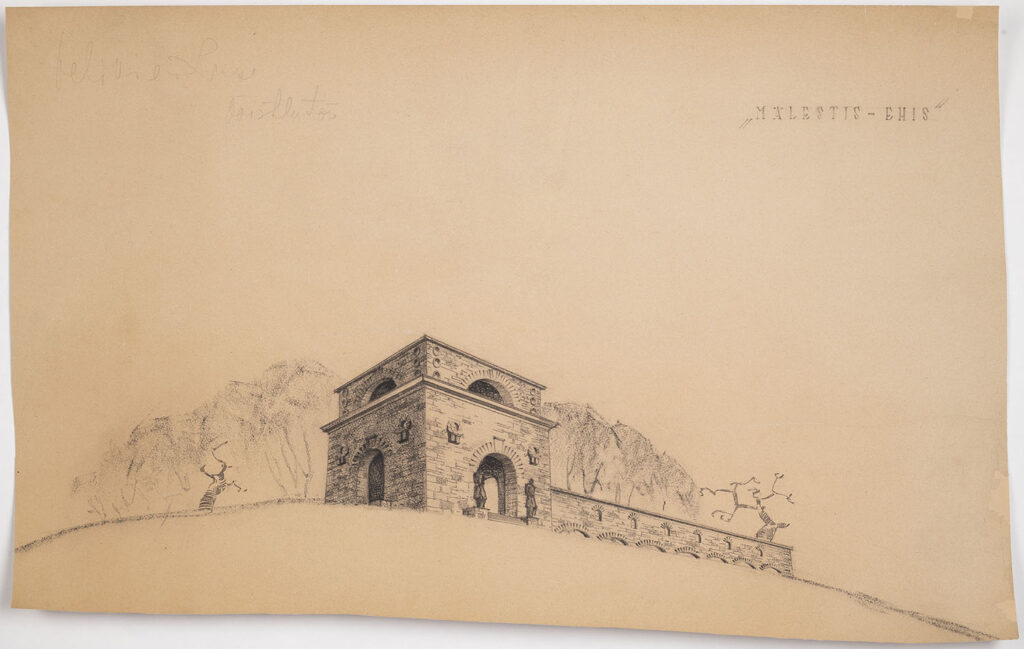
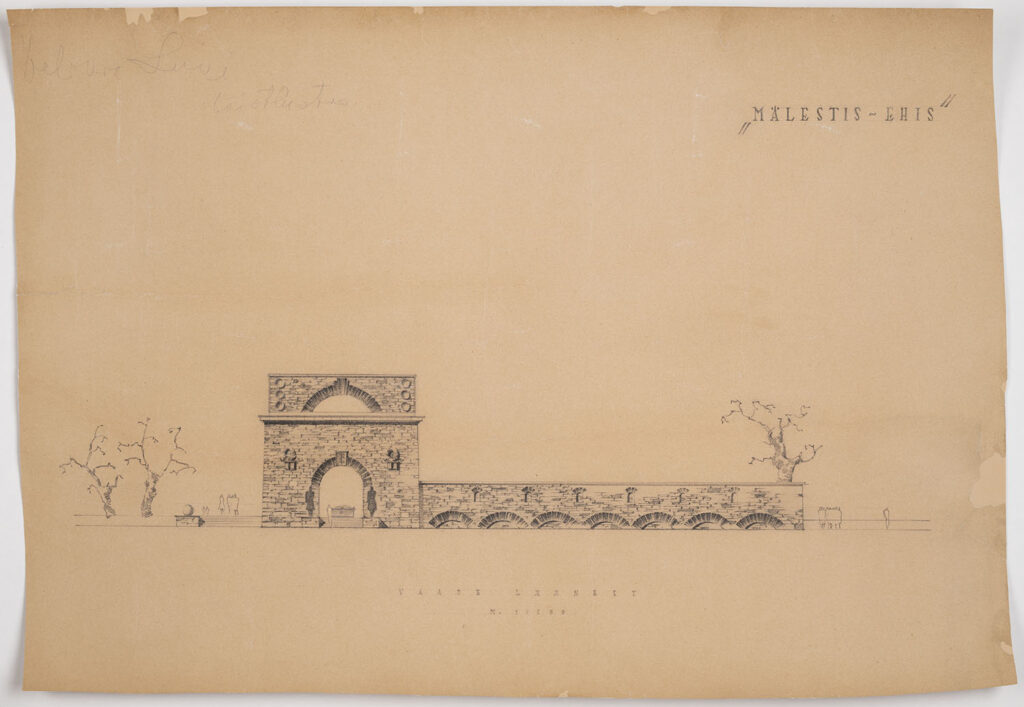
The War of Independence monument competition work “Mälestis-ehis”
The story of the monument begins in the 1920s, when the statue of Peter I standing on the Freedom Square was taken down (1922) and it was decided to erect a statue of the War of Independence in its place. The construction of the monument delayed, and instead a massive limestone memorial-mausoleum designed by Edgar Johan Kuusik was erected at the Defence Forces Cemetery (1928). At the end of 1930, when the competition for the construction of a War of Independence monument on Harjumäe was announced, Edgar Johan Kuusik in cooperation with Elmar Lohk submitted two works for the competition. The competition entry with the keyword “Mälestis-ehis” repeats the same motif as the memorial-mausoleum in the cemetery – a massive cubic volume with four arches opening towards the four cardinal directions. However, the prize went to the authors’ second work “Pro Patria”. Later, Kuusik used the same style at the gate building of the Defence Forces Cemetery (1938). The competition work “Mälestis-ehis” was donated to the museum by the E. J. Kuusik family in 2021, the drawings were conserved in Conservation and Digitisation Centre Kanut. Text: Anne Lass
Toomas Rein, 1983. EAM 48.2.8
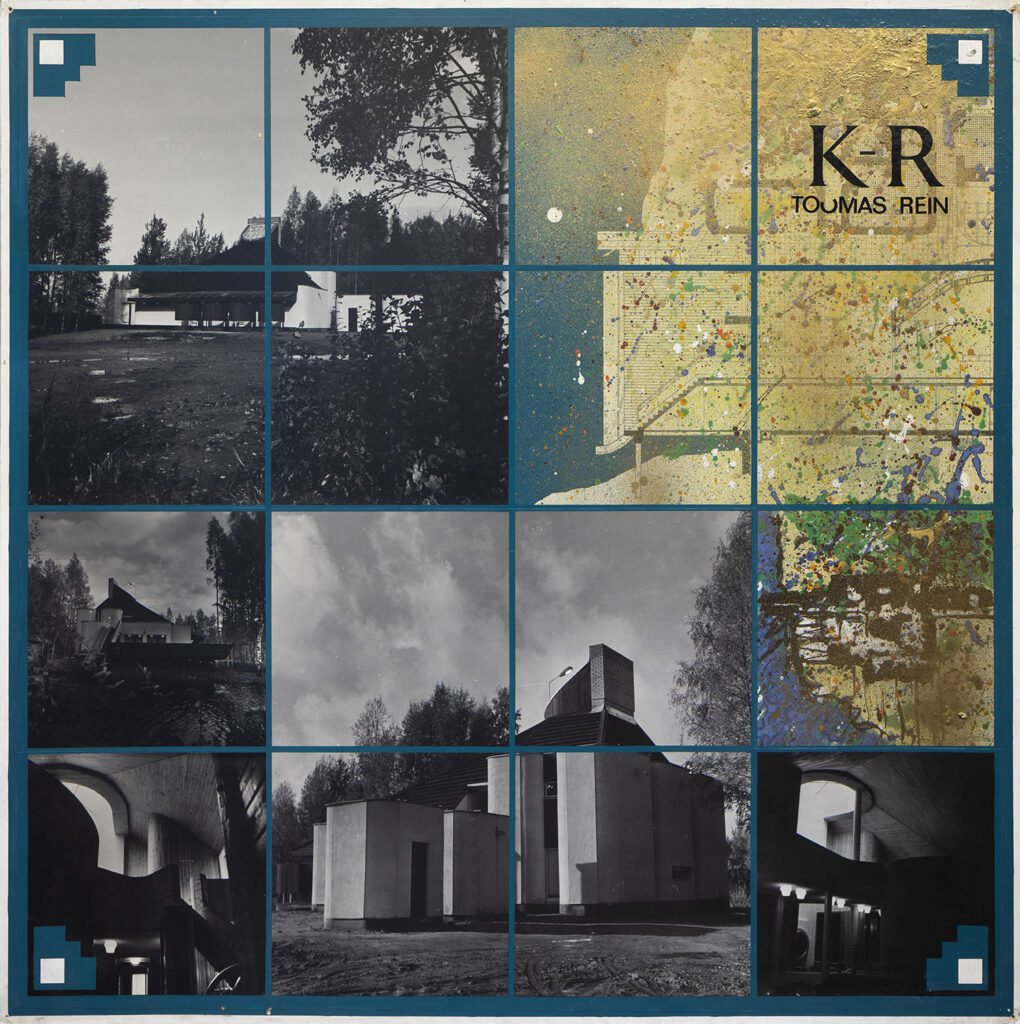
Sauna in Kobela
The Linda kolkhoz sauna, designed by architect Toomas Rein, is located in the small village of Kobela in Võru County and is one of the great examples of Estonian rural architecture. Articulated volumes, rounded corners and a red high pitched roof give character to the two-storey building, red wooden details on the windows and doors add contrast to the white facade. The sculptural exterior of the building is also reflected in the interior designed by interior architect Aulo Padar. On the first floor there was a common room with a fireplace, utility rooms and an indoor pool, on the second floor there was a sauna and laundry rooms. An indoor slide between the two floors led from the hot sauna to the cooling indoor pool. From the second floor there is also an access to the terrace of the building, from there a slide and stairs lead to the pond next to the sauna. During the renovation in the early 1990s, the function of some rooms changed and a club started to operate in the building – the indoor pool was covered with a floor and the indoor slide was demolished, the light shaft on the second floor and the glass roof were closed. The composition merges architecture, geometry and abstract painting – black and white architectural photos are arranged in a regular grid, the cross-section of the building and the ground plan are covered by a layer of gold paint and colour spots. Text: Anna-Liiza Izbaš
Mart Port, Uno Tölpus, Raine Karp, Olga Kontšajeva, 1963. EAM 4.3.2
Estonian Ministry of Foreign Affairs building
The 11-storey administrative building influenced by the American so-called International Style was completed in the Tallinn city centre in 1968. The symmetrical facade of the building is characterized by regular rows of ribbon windows and a vertical windowless central part, which was supposed to form the background for the statue that stood in front of the building. The building has a U-shaped ground plan. On the first floor of the office building is a spacious vestibule, the walls of the vestibule were covered with pink Cuban origin marble. The offices are located on the following floors, the utility rooms are on the top floor. Conference and meeting rooms are located in the wing buildings, there is a courtyard in the middle of the building parts. A broad hyperbolic paraboloid-shell made of reinforced concrete covers the large conference hall located in the left wing of the building. Due to the complex construction, the lights were installed on the walls of the room and the ceiling was covered by 60,000 empty sprat boxes. The oiled and round sprat boxes helped to diffuse and reflect the light directed at them and ensured good acoustics in the hall. The location of the building is also significant. The office building was built on the site of the Estonian Academy of Sciences, which was foreseen by 1948 Tallinn Cultural Centre design plan (architect Harald Arman), on the other side of the Theatre Square is the “Estonia” theatre – politics and power is facing culture and spirituality. Since the autumn of 1991, the Estonian Ministry of Foreign Affairs has been operating in the former Estonian Communist Party Politburo building. The author of the drawings is Rein Kersten. Text: Anna-Liiza Izbaš
(klick on the picture to see more illustrations)
EAM 3.4.9; EAM 3.4.12; EAM 3.4.14
Competition works of rural cultural centre
At the end of 1947, an architectural competition was organized to find the best solution for the standard project of rural area cultural centres. 40 concept designs were submitted to the competition. Despite the large number of participants, the jury was only satisfied with the projects depicting the municipality culture centres. The first and second prizes were shared equally by Henn Roopalu’s work “Agitator” and August Volberg’s and Peeter Tarvas’ work “Tuljak”. The successful facade and plan solutions of the works were highlighted. The third prize went to the project “200” by architect Ilmar Laasi. In the opinion of the jury, the concept designs of the village’s cultural centres were of a significantly weaker level, which is probably the reason why the first and third place were not awarded. The concept design “Accent” by August Volberg and Peeter Tarvas was recognized with the II prize. At that time, community and cultural centres played an important part in the country’s cultural policy, what happened in them was controlled by the ruling power and carried the Soviet ideology to a greater or lesser extent. Text: Anna-Liiza Izbaš
(klick on the picture to see more illustrations)
-
-
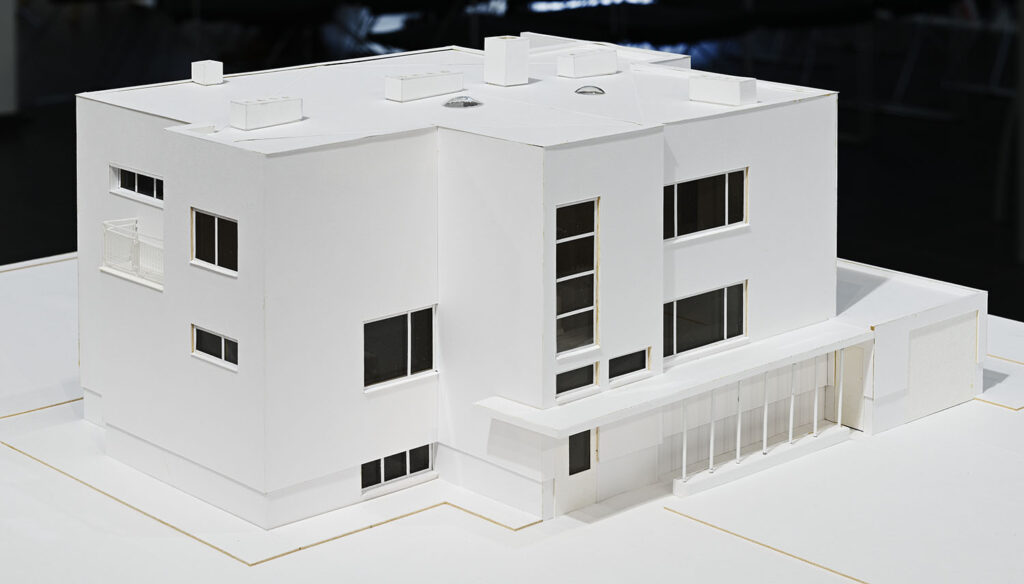
Villa Tammekann makett, autor Peet Veimer
Alvar Aalto, 1932. Maquette: Peet Veimer. EAM MK 47
Villa Tammekann in Tartu
February 3 is the 125th anniversary of the birth of the world-famous Finnish architect Alvar Aalto. The private residence of the University of Tartu professor August Tammekann at Kreutzwaldi st. 6 Tartu is the only completed building in Estonia designed by architect Aalto. The flat roofed, two-storey functionalist building was partially completed in 1933. According to the style’s principles, the building’s facade reflects the usage of the interior spaces. On the street side, a stairwell rises behind the vertical window, on the courtyard side, the central element is the wide ribbon window of the living room with a fireplace located at the bottom of the window. The flat roof of the house, which was not widespread at the time, caused a lot of discussion among the locals and was even considered as an anti-God phenomenon. The villa was rebuilt into an apartment building during the Soviet period. In 1994, the building was returned to Professor Tammekann’s offspring, in the 1998 University of Turku bought the building. The villa was restored according to Alvar Aalto’s project in 2000. Today, the Granö Centre of the universities of Turku and Tartu is located in the building.
The maquette of Villa Tammekann was made for the Estonian Architecture Museum exhibition “Aalto: three projects in Estonia” by Peet Veimer in 1998. Text: Anna-Liiza Izbaš