Erika Nõva, 1939. EAM 2.6.34
The competition project of physical culture centre “Siseõu”. II prize
Sports and physical culture become the keywords of modern life in the mid-1930s. Planning a representative sports building in Tallinn become on the agenda. A suitable location was found in the Falkpark (today Falgi Park) located at Toompuiestee. In November 1938, the architectural competition was announced. The plan was grandiose: the building had to hold a main hall (20×40 m) for gymnastics, basketball and volleyball, tennis, wrestling, weightlifting and other fields. The stands had seats for 4,500 spectators. Another large room group consisted of a swimming pool (14×25 m) and two saunas, and the third was a gymnasium. In addition to training, dressing and washrooms, office spaces and apartments for officials were also planned. The international competition ended in April 1939. Finnish architects Enn Muistre and Einar Teräsvirta won the first prize, the third prize went to Latvian architect Arturs Reinfelds. Erika Nõva, one of the first female architects in Estonia, received the second prize. The award committee highlighted Nõva’s urban-planningly successful solution “… because the semicircular forms relate architecturally well to multi-directional streets.” The solution of the main hall, the swimming pool and the central part of the building was called magnificent / Eesti Arhitektuur. Varamu arhitektuuri osakond nr 3, 1939/. Erika Nõva recalls: “This job started to bother me. I thought I don’t deserve it, but I couldn’t give up the thought either. Little by little, I began to observe related examples from foreign magazines and tried to sketch it according to the program. When I showed these sketches to Kotli and Soans /… /, they encouraged me to continue working.” / Erika Nõva. Minu töö ja elu. Tallinn, 2006, p. 61/. What follows is a long and cheerful description of the work-hours at night, the draftsman’s assistant Tsinovski (Nopski), the nerve-wracking moments when sending off the work at the post office of Nõmme station, the victory celebration at the “Ehitaja” office and later at Mustamäe’s home. Text: Anne Lass
-
-
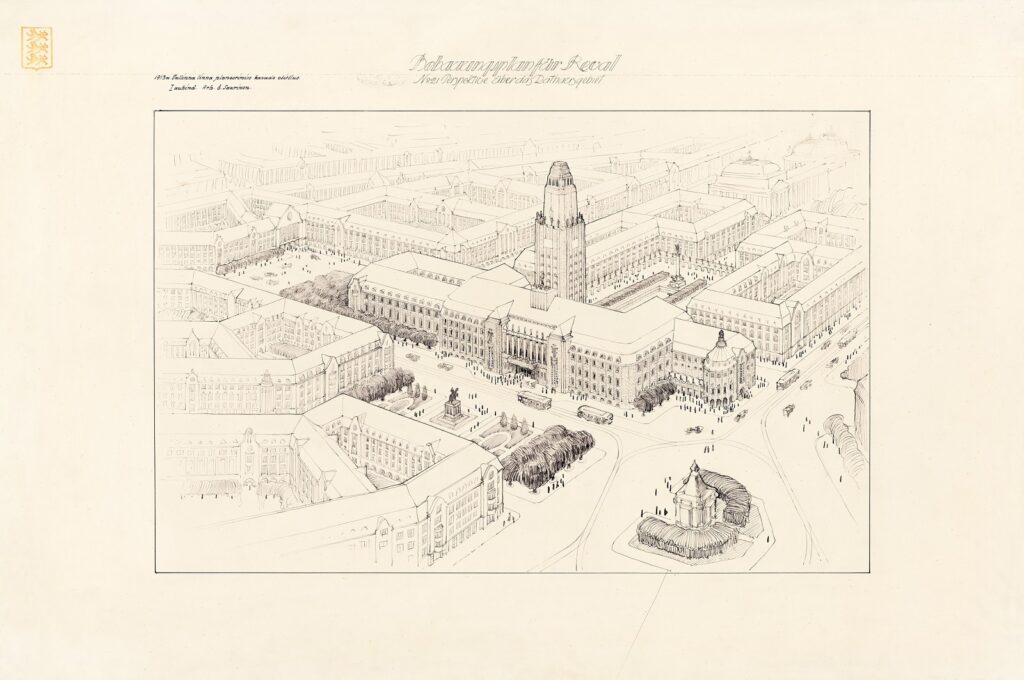
“Suur-Tallinn” (Greater-Tallinn) master plan, 1913. Eliel Saarinen
-
-
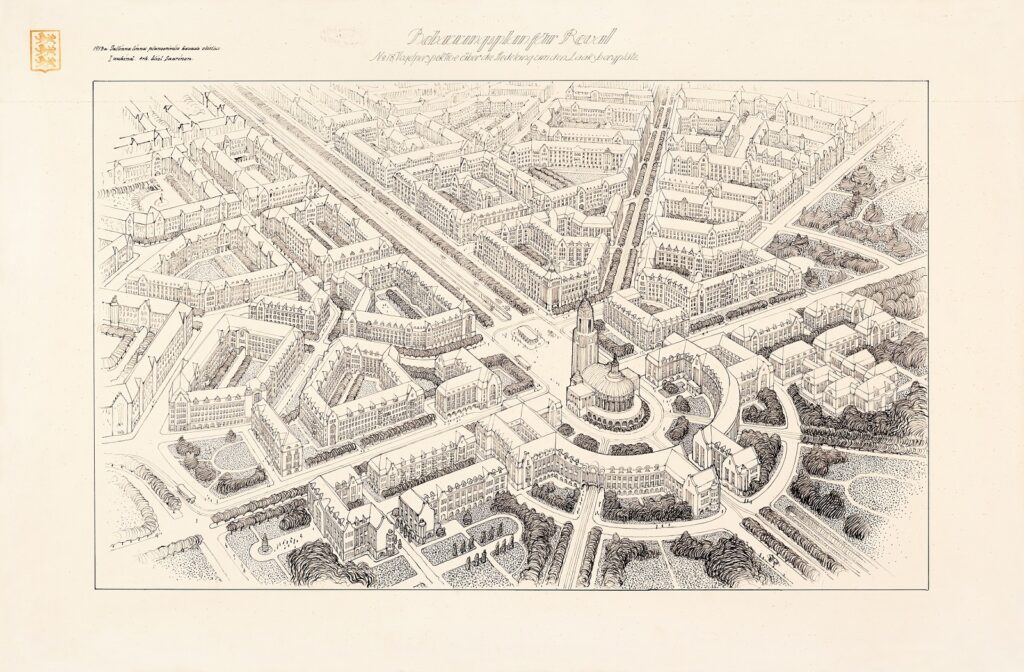
“Suur-Tallinn” (Greater-Tallinn) master plan, 1913. Eliel Saarinen
Eliel Saarinen, 1913. EAM 1.1.8
“Suur-Tallinn” (Greater-Tallinn) master plan
In the early 20th century, Tallinn was transforming from a sleepy provincial resort town into a modern, mid-sized European city. Rapidly developing industry and population growth resulted in the need to give consideration to the city as a comprehensive system. Finnish architect Eliel Saarinen had already worked with plans for developing Budapest, Helsinki, and Canberra. Thus, his first-place prize in the 1912–1913 competition for a general plan of Tallinn was somewhat expected. Saarinen’s entry is monumental: the city centre would be stocked with six-storey stone buildings, while worker-class neighbourhoods would be reformed with row-houses. This year is the 150th anniversary of the birth of architect Eliel Saarinen. The drawings, which belonged to the Tallinn City Government for a long time, were recently given to the museum.
Text: Sandra Mälk
-
-
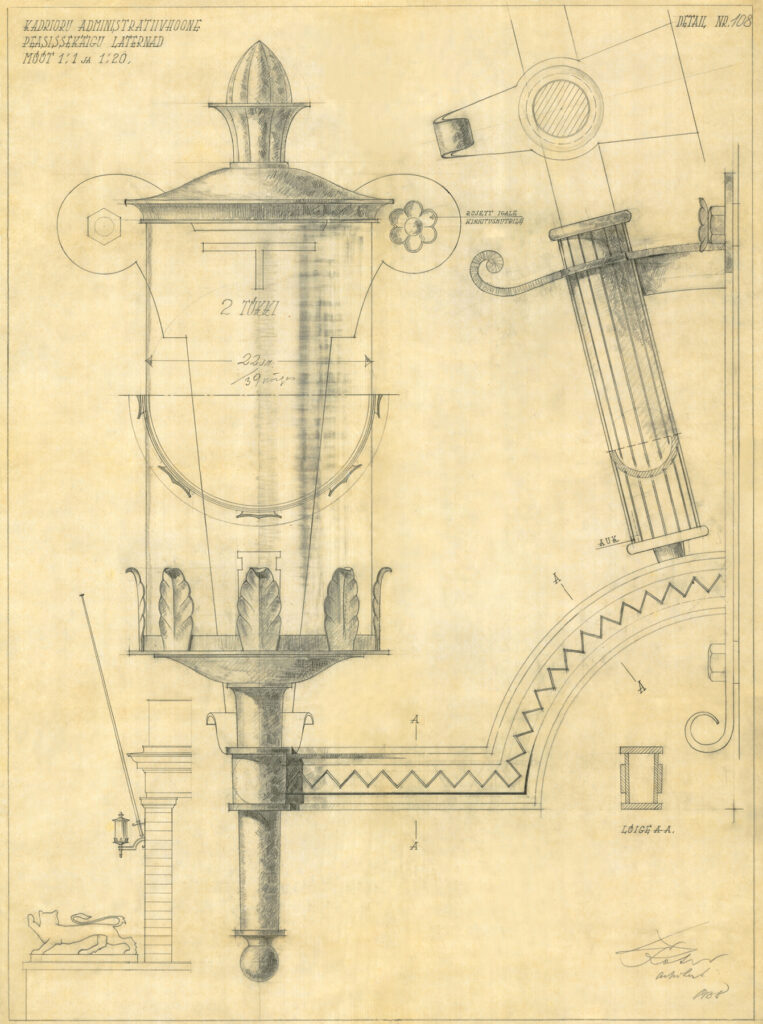
Lantern drawing of the President’s Office, Alar Kotli, 1938
Alar Kotli, 1938. EAM 2.9.2
Lantern drawing of the President’s Office
The main entrance of the President’s Office is flanked by lanterns featuring abundant rosettes and leaf motifs which comprise an integral whole with the Neo-Baroque architecture. Seeing as this is a representative building, there are sockets for flag poles above the lanterns. The drawing also depicts a familiar motif from the coat of arms of Estonia – a bronze leopard (by sculptor Voldemar Mellik) set to guard the doorway on both sides. This pencil drawing was part of the colletion given to the museum in 1993 via firm Eesti Ehitusmälestised. Text: Sandra Mälk
-
-
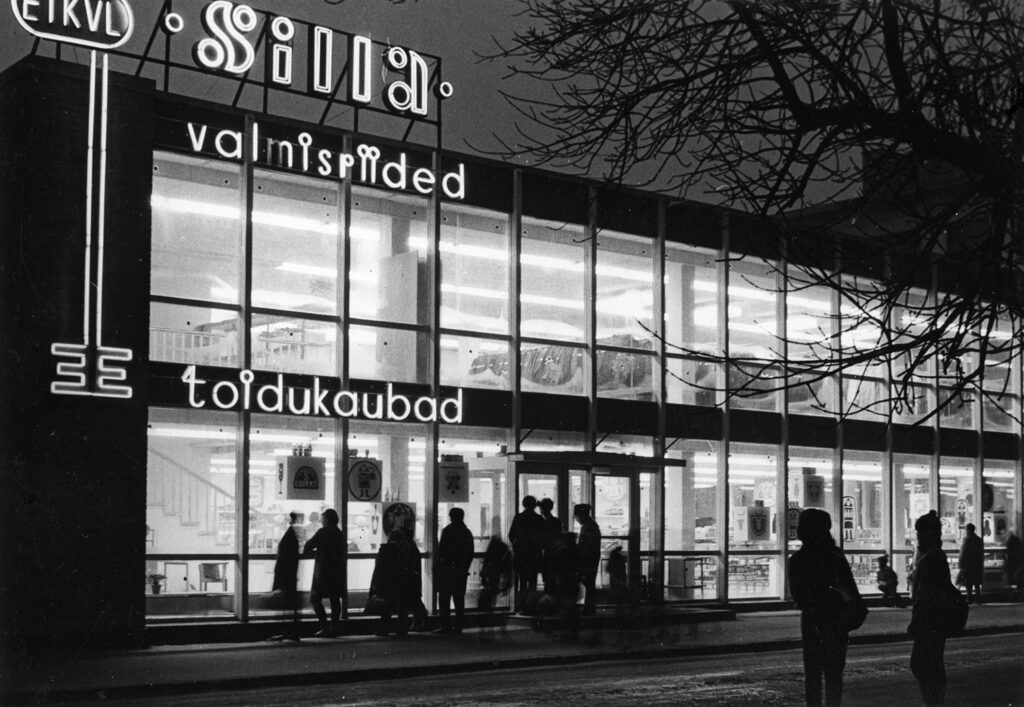
Shop “Silla” in Pärnu, photo by Rein Vainküla
-
-
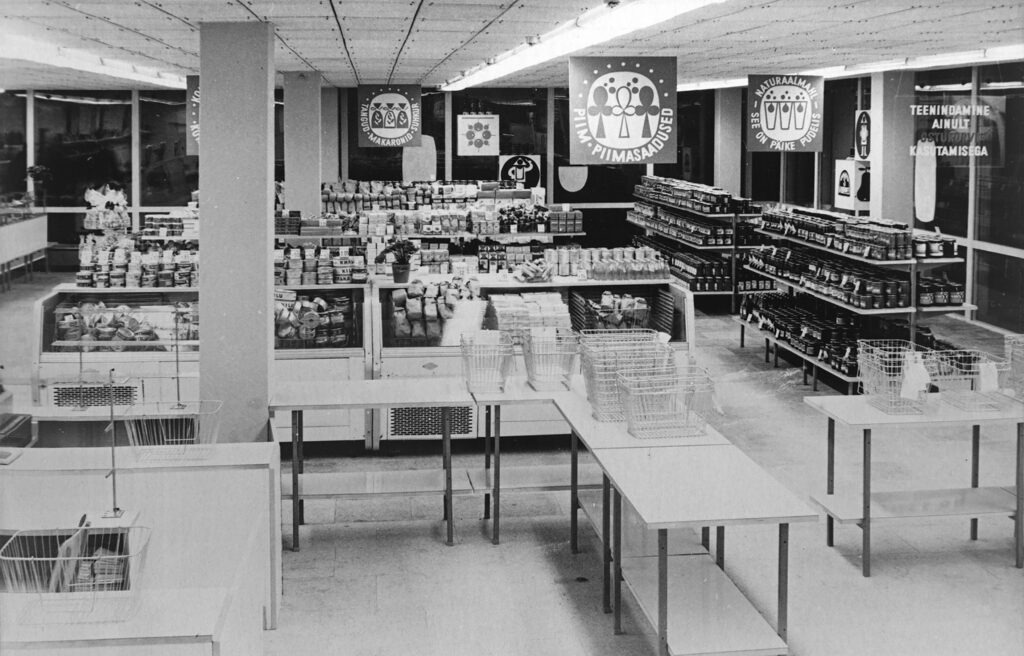
Shop “Silla” in Pärnu, photo by Rein Vainküla
Rein Heiduk, 1964. EAM 6.4.7:76. Photo: Rein Vainküla
Shop “Silla” in Pärnu
In 1968, a newly opened shop designed by Rein Heiduk on Silla street in Pärnu attracted the attention of passers-by with a modern look. Reminiscent of a glass pavilion, the store “Silla” hid food products on the first floor and industrial goods on the second floor. When writing about the architecture of the building, the architectural historian Leonid Volkov has referred to its connections with both the international style and the constructivism of the 1920s (L. Volkov’s manuscript “Eesti arhitektuur 1940-1989. Part II, p. 103). The Estonian Consumers’ Cooperative Union (ETKVL) was responsible for the fresh production of the store network that consolidated the pan-Estonian trade network and, for example, opened the Tapa department store, which was also designed by Rein Heiduk (1966). In 1994, Leonid Volkov’s wife Helga Volkov handed over a manuscript dedicated to Estonian architecture to the museum along with a rich photo collection. The house was photographed by Rein Vainküla. Text: Sandra Mälk
-
-
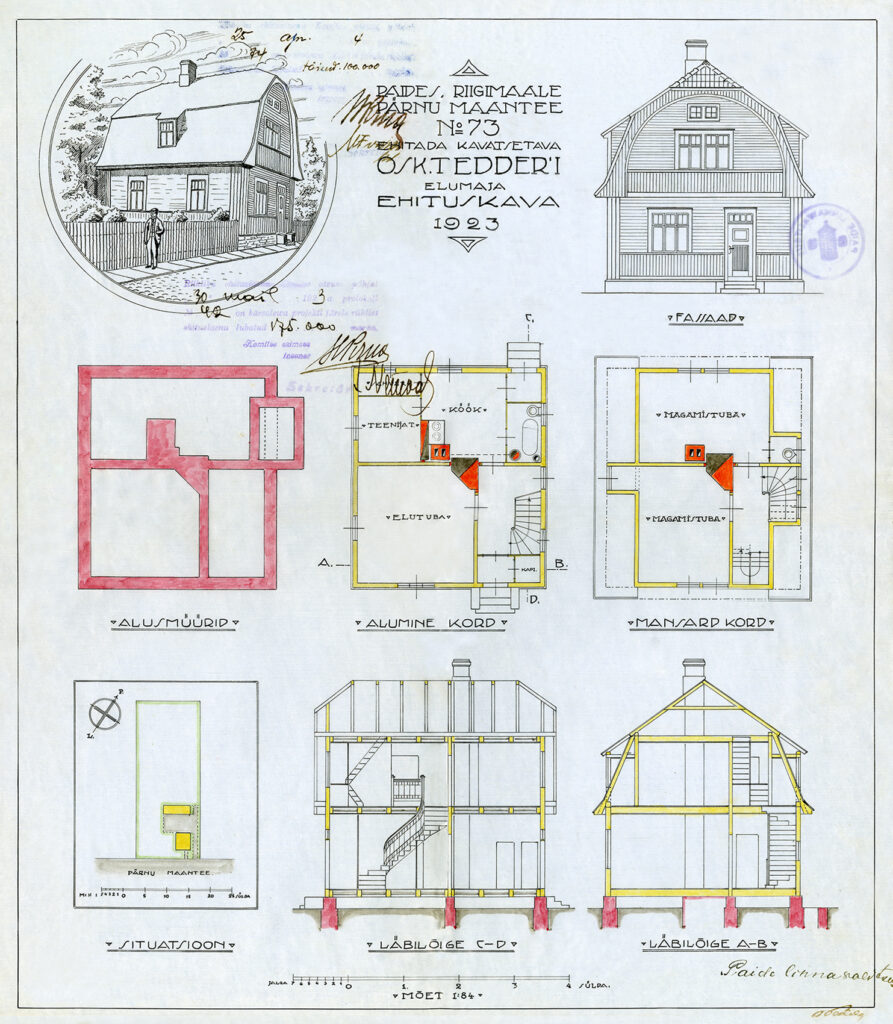
Residence in Paide
Residence in Paide
House in Paide
It was not overly common to commission house designs from a professional architect in the early 1920s, especially in towns and boroughs – designs were often made by building technicians and civil engineers. Compared to nowadays, the project seems unusually compact. One sheet would feature all the information about the house: views, floor plans, sections and every now and then a perspective view to please the client and show the general appearance of the future house. The house of Oskar Tedder who commissioned the project to acquire the building loan, was constructed on one of the main streets of Paide where the state handed out empty plots to establish a new garden city-like housing area. The project made in ink on the drafting cloth was added to the museum’s collection in 1992. Text: Sandra Mälk
-
-
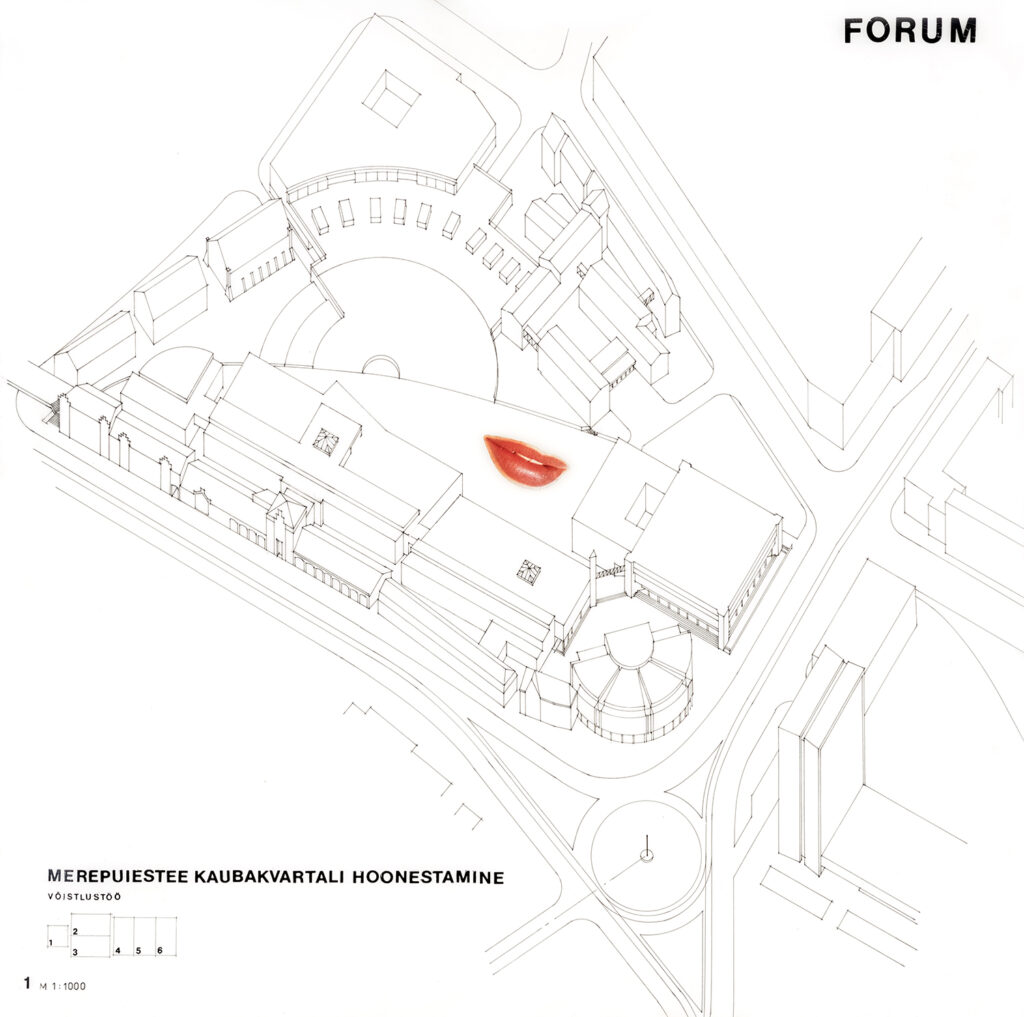
Shopping center in the Rotermann quarter. Competition work, 1989
Tiina Tallinn, Ell Väärtnõu, Arvi Aasmaa, engineer Rein Karilaid, 1989. EAM 5.1.21
Competition entry for the shopping centre at Mere Boulevard in Tallinn
Up until now the factory premises of the Rotermann Quarter had been closed off and an architectural competition was organised to find a way to better incorporate the area into the urban landscape. The quarter was to be the main commercial and service centre of Tallinn. The centre of the competition entry titled “Foorum” is a crescent market square – a modern interpretation of the historic forum in ancient Rome, together with all the surrounding market pavilions. The idea of market as a place of communication is further emphasised by a collage detail of lips as a means of communication. The competition entries were given to the museum in 1993 by the Tallinn City Office. Text: Sandra Mälk
-
-
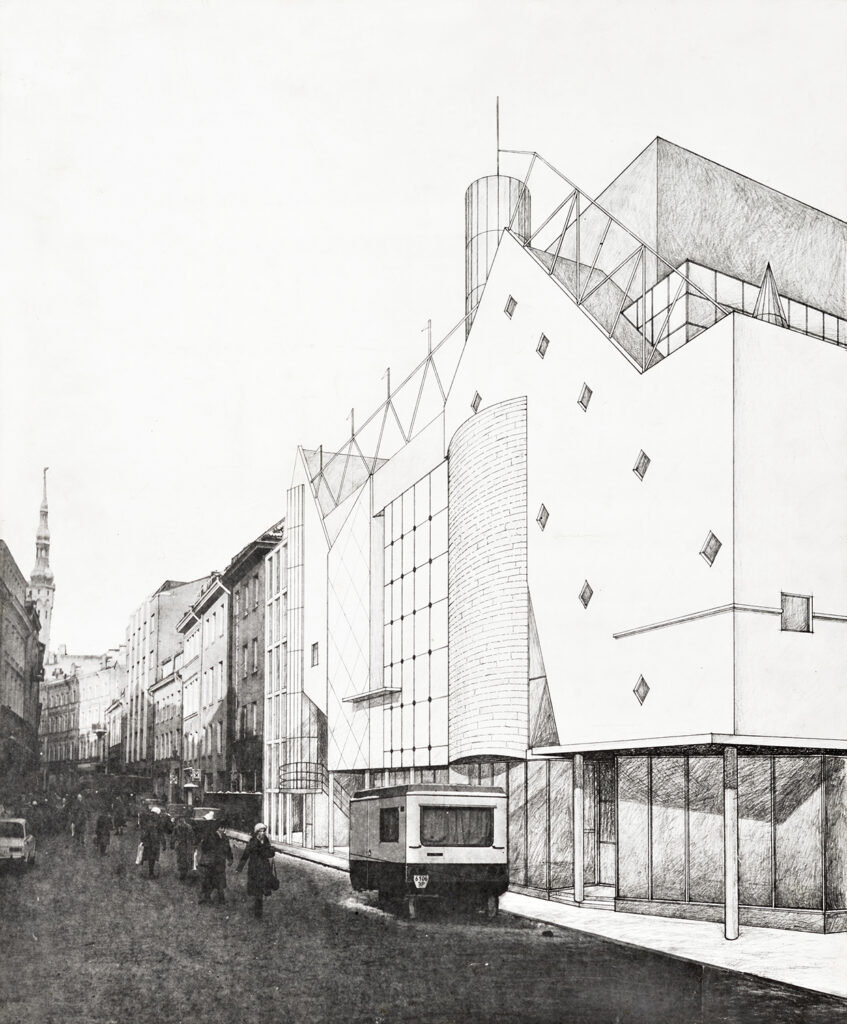
Vanalinnastuudio Theatre project. Vilen Künnapu, Ain Padrik, 1987
-
-
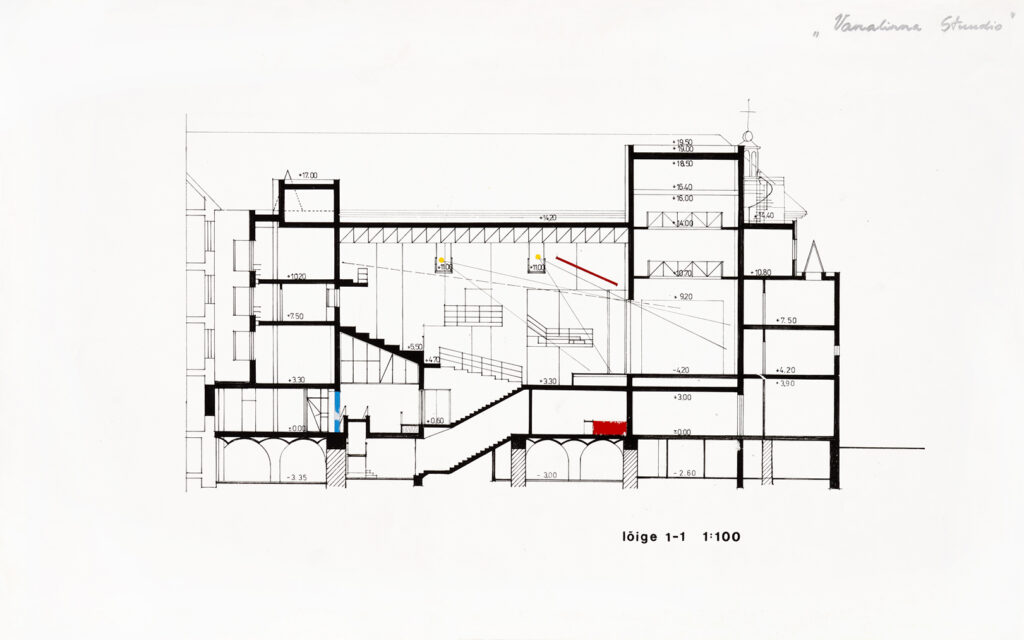
Building section
-
-
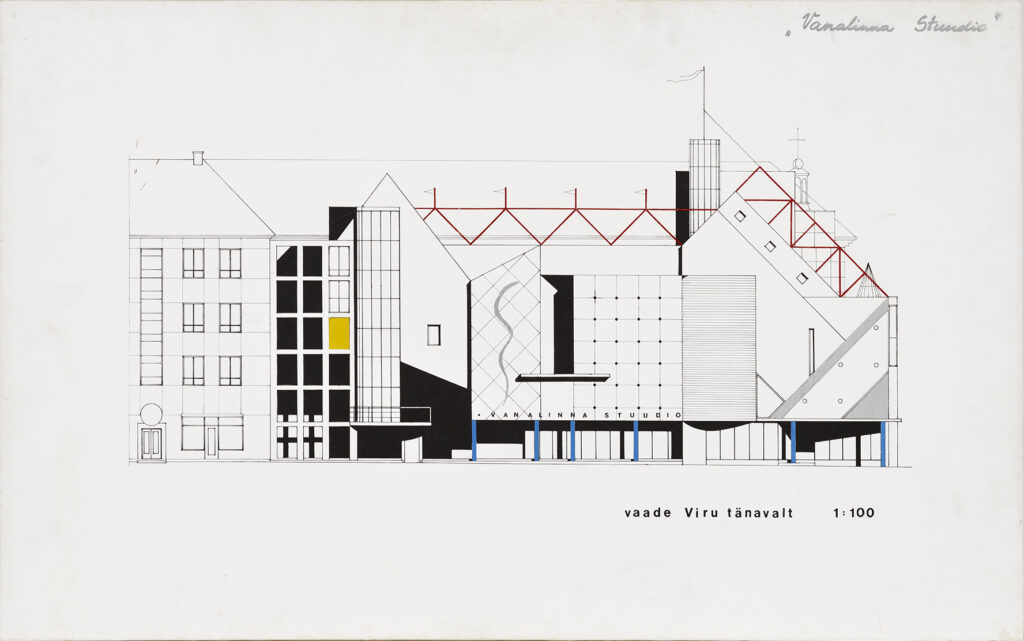
Vanalinnastuudio theatre building in Tallinn
Vilen Künnapu, Ain Padrik, 1987. EAM 41.1.16
Vanalinnastuudio theatre building in Tallinn
Comedy theatre Vanalinnastuudio, which started out in Tallinn Teachers’ House, became so popular under the leadership of the legendary theatre director Eino Baskin that in the mid-1980s there was an idea of building the theatre its own house in the Old Town. The beginning of Viru Street had a plot that had long been vacant (currently the De la Gardie shopping centre, 1999) and it was considered as one possible location for the building. The theatre house was designed as a black box theatre with seats for 200 people and an attic storey for lowering decorations to the stage below. The postmodernist building was never constructed under the new political regime. The display board together with the section and view was given to the museum in 2005 by architectural historian Liivi Künnapu. In addition to that, last year the architecture office Künnapu&Padrik donated their drawings and digital archive to the museum. The lot, consisting almost 200 projects, is in the final process of adding to the musem’s collection. Text: Sandra Mälk